Search Everything Octopus

Monday, December 19, 2011

Octopus Baby Blanket

Looking for something snuggly and octabulous for your newborn? I found just the thing for ya!

Etsy.com seller, Angela Curtis, has been crocheting for over 23 years and has been kind enough to share her creations with the world through her many Etsy stores. There are beautiful baby blankies, plushies, scarves and more available at All Things Granny, including this adorable octopus baby blanket.

"Crocheted Baby Blanket - Granny Border Octopus

Granny Square Baby Blanket made with High Quality Acrylic Blend Yarns.

This blanket was lovingly crocheted in a stitch pattern that I call the thermal stitch, because the finished product looks similar to a thermal blanket.

The newest addition to our line of Baby Blanket is our Octopus Motif. He measures 8" x 8", and is securely sewn down to the blanket in one corner.

**This blanket is a Made to Order item, and will be sent to you within 4 weeks time, ready to use, perfect for a gift, and comes from my non-smoking home.**

You may specify different colors if you like.

It is very soft. Measures approx 20" xx 30".

With my 35 years of crochet experience I bring a quality product to you. Each of my products is well made, and should be considered an heirloom piece to pass down in families for many generations to come. All ends are tied into the work, all stitches are uniform.

This blanket is ready to use, perfect for a gift, and comes from my non-smoking home. It will be shipped to you in a nicely wrapped package."

Thursday, December 15, 2011

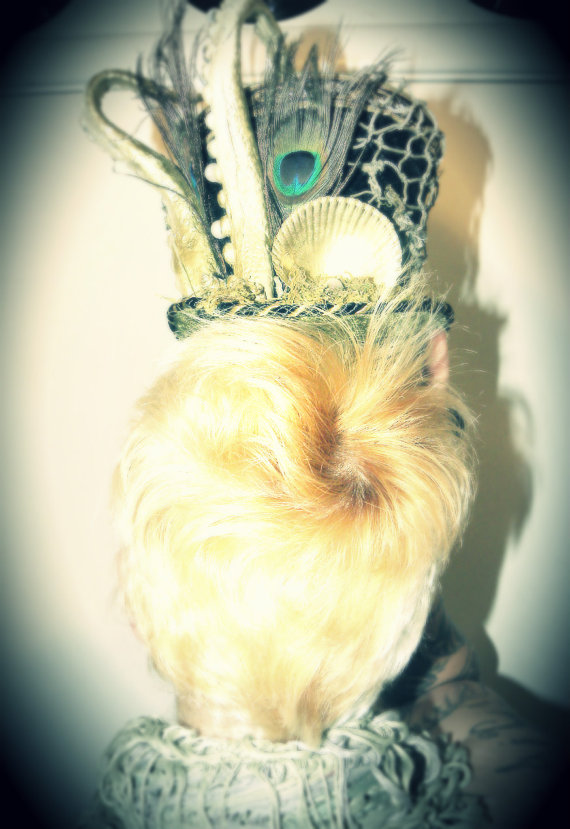
Shipwreck! Fabulous Octopus Top Hat from Etsy.com

Etsy.com seller, JellyfishVintage aka Mrs. Jones believes that quality and craftsmanship are essential for creating memorable clothing and accessories that will last a lifetime and ensure that you always look fabulous! Mrs. Jones has handcrafted a fantastic made-to-order octopus hat worthy of even the most discriminating cephalophile. Behold...

"This mini top hat facinator, is by far my favorite i have ever made. It is a hand constructed top hat lined in high quality soft crushed velvet, in black and moss green, the it is adorned with jeweled golden octopus legs and golden sea shells, even a gold authentic starfish perches on top. There is fisherman's net draped over it and dried moss too, peacock feathers and a chained emerald swinging on the base, the clams even have pearls! Perfect for a pirate who wants to be a bit out of the ordinary!

Secured with a non slip headband that can be hidden under the hair.

Surprisingly lightweight and comfy for all night wear"

This stunning octopus hat and several other cleverly crafted goodies are available at JellyfishVintage. Happy top hat shopping!

Tuesday, December 13, 2011

Sea Lion vs. Octopus

Originally posted December 12, 2011

KPLU.org - news for Seattle and the Northwest

Last Wednesday, Dec. 7, Everett Herald photographer Mark Mulligan caught a rare sight on camera – a sea lion feeding on an octopus. (See above video)

It is a seldom occurrence to witness the splendor of marine life. The limited encounters that we have with such fuels curiosity and interest.

Seattle aquarium’s curator of mammals and birds, Traci Belting, shared some insight into the diet of sea lions.

“Local sea lions are opportunistic and will eat anything they can,” said Belting. “In the past, necropsies on sea lions have found octopus beaks in their stomachs.”

It’s not uncommon for sea lions to feed on octopus, given its wide dietary patterns. Sea lions don’t chew their food; the only time we are able to see them feed is when they surface to tear their prey into smaller pieces to swallow whole.

“Octopus are usually pretty evasive and make for cunning prey,” said Belting.

Monday, December 12, 2011

Octopus Walks on Land

Originally posted November 23, 2011

CBSNews.com

(CBS) - The Animal Kingdom is full of wondrous creatures. We are constantly surprised at what animals are capable of. But this is just nuts. Did you know that an octopus could walk on land? Because I had no idea. And this video blew my mind!

There have been videos of octopi on land before, but they're usually along the lines of a little guy falling out of a tank or being placed on the ground. This rubbery explorer just straight up walks out of the water. It's even carrying a crab the whole time.

It is well known that octopuses are exceptionally intelligent. It seems like there's nothing these charming cephalopods can't do.

Sunday, May 29, 2011

Octopuses Capable of Hand-Eye Coordination

By Helen Albert, CosmosMagazine.com
May 30, 2011

LONDON: Octopuses are able to use visual cues to guide a single arm to a location, a complex movement that was not thought possible due to their lack of a rigid body structure, say researchers.

The octopus' arm is made up primarily of muscle with no skeletal support, so octopuses were previously believed to have a low level of body awareness and only limited control over their limbs. However, this study has shown for the first time that they can direct a single arm in a complex movement to a target location.

"Octopuses have a central nervous system that is advanced for an invertebrate, but simple compared to a vertebrate, yet it is capable of controlling a much more 'difficult' arm," said lead study author Tamar Gutnick, a researcher at the Hebrew University of Jerusalem in Israel.

"Because of the unique body plan of the octopus its ability to control a single arm in a complex movement is quite amazing."

Too soft for complex movement?

Octopuses were thought to have no conscious central nervous system-directed (CNS) control over their arms with movement being controlled solely by the activity in the complex array of nerves (PNS) present in the limbs.

However, the visual aspect of the task carried out by the octopuses in this study suggests that there must be an exchange of information between the CNS and the PNS during such behaviours.

Photo by Tamar Gutnick

In Gutnick and colleagues' experiment, six out of seven octopuses succeeded in using a single arm to select a visually marked compartment containing a food reward in a three-choice, plexiglass maze.

The animals were required to reach the compartment containing the food reward at least five times in a row out of a total number of trials ranging from 61 to 211. The octopuses could only use one arm to complete the task, as the tube leading to each compartment was only wide enough for one limb.

How brains control behaviour

The team observed that the chance of a successful trial improved significantly during the last 20 trials for each animal compared with the preceding trials.

They also noted that the animals seemed to learn that they needed to see the three boxes to improve their chances of getting the reward and were significantly more likely to be in view of the boxes during the last 20 trials than during the earlier tests.

The octopuses also adapted their arm use strategy from mostly 'straight', involving a direct unrolling or pushing upwards of the arm through the tube, to a 'search' strategy, involving probing and crawling in the central tube and above the choice boxes before deciding on a compartment.

Photo by Michael Kuba

It's not automatic

"This is a very important step in our knowledge of octopus behaviour," commented Jennifer Mather, a professor of psychology and expert on octopus behaviour at Lethbridge University in Alberta, Canada.

"The octopus has a large number of complex arms, and the question of how they manage to guide all of them is a fascinating one. We had previously thought that it might be fairly automatic or that their control was more at the local level within the arm. This is good evidence that local control need not be all," she added.

Studies involving octopus motor control, such as this, are the foundation of a current European Union research project to develop a robot octopus (Octopus Project). The aim of the project is to design and produce a soft-bodied robot that moves and squeezes through narrow spaces in a similar way to a biological octopus.

"Depending on the size of the robot its use could be from medicine (constructing new soft-bodied ultra flexible surgical tools) to big robots that could be used in search and rescue," said Gutnick, who is continuing her research on motor control.

"We are continuing to look at single arm tasks where animals are taught using a variety of senses, exploring the involvement of central and peripheral information," she said.