Search Everything Octopus

Showing posts with label Pacific Ocean. Show all posts

Tuesday, May 1, 2012

Video: Octopus with a Tin Can Mobile Home

CNN iReporter, Robert Suntay, shot this incredible underwater video of an octopus lugging a tin can along the sea floor in the Philippines. It appears that the can is being used for shelter. Further proof that octopuses are smarter and more capable than we know!


Can anybody name that octopus???

Monday, February 27, 2012

Octopus Symposium & Workshop at the Seattle Aquarium!!!

Last week was Octopus Week at the Seattle Aquarium. Locals had a opportunity to learn about one of the coolest creatures in Puget Sound, the Giant Pacific Octopus. There were daily hands-on activities, octopus feedings, and even a live ocotpus release.

If any Everything Octopus readers paid a visit to the Seattle Aquarium last week, please let us know how it was. You can email me pictures at EverythingOctopus@gmail.com to be shared with our ceph-loveing community.


Be sure to save the date for the upcoming Octopus Symposium and Workshop at the Seattle Aquarium.


Octopus Symposium & Workshop Presentations and Speakers

Is the GPO the octopus archetype?
Jennifer Mather, University of Lethbridge (Lethbridge, Alberta, B.C.)

Temperature, movements, and anesthesia of giant Pacific octopuses.
David Scheel, Alaska Pacific University (Anchorage, AK)
David Scheel’s student, Alaska Pacific University (Anchorage, AK)

Escaping the Kraken’s Grasp: A Sponge-Scallop Mutualism Possibly Maintained by Octopus Predation
Kirt Onthank, Washington State University (Pullman, WA)

Evidence for inter-sucker coordination during different arm movements in the giant Pacific octopus
Stavros Hadjisolomou

Preliminary results of population genetics analysis of Giant pacific octopuses in Washington, Oregon and British Columbia
Shawn Larson, Seattle Aquarium (Seattle WA)

The Legacy of Olive
Guy Becken, Seattle Aquarium (Seattle WA)
Kathryn Kegel Seattle Aquarium (Seattle, WA)

Close relatives of the giant Pacific octopus
Ian Gleadall, Tohoku University (Sendai, Japan)


Monday, April 4, 2011

New Giant Pacific Octopus joins Aquarium of the Bay

SFExaminer.com
March 28, 2011

A Giant Pacific Octopus will be getting its tentacles wet as the newest addition to an aquarium in San Francisco, officials said.

The Aquarium of the Bay welcomed the octopus Thursday after purchasing it from a local crab fisherman, according to the aquarium.

Giant Pacific Octopuses crave crabs and den-like enclosures, and often mistake crabbers’ nets as hunting and hiding ground, where they are unintentionally caught, aquarium officials said.

If the octopus kills and eats the crabber’s catch, many fishermen retaliate by killing the octopus, according to the aquarium.

Aquarium of the Bay tries to change this behavior by working with fishermen and purchasing octopuses for exhibit.

The aquarium said it advertises this financial opportunity by posting fliers around local piers and tackle stores.

The newest inhabitant to the aquarium, a true testament to its name, weighs over 80 pounds and joins three other Giant Pacific Octopuses in the aquarium’s near-shore tunnel exhibit, officials said.

Giant Pacific Octopuses are professionals at the art of disguise and can change color within a fraction of a second, by stretching or squeezing their skin, according to the aquarium. Their typical lifespan is about five years.

“Aquarium of the Bay is always happy to provide a safe haven for octopuses that would otherwise meet a hasty demise,” Christina J. Slager, the aquarium’s director of husbandry, said in a news release.

The aquarium is a nonprofit marine life center, dedicated to cultivating the conservation of the San Francisco Bay and its watershed.

(O)(o)(O)(o)(O)>

Stay tuned for details on the latest Everything Octopus contest and how you can win!

Tuesday, February 23, 2010

Octopus Goes Looking for Love at the Seattle Aquarium

Published 02/15 on KomoNews.com
Written by Theron Zahn

SEATTLE -- Six hearts and 16 arms went on one very complicated blind date this past Valentine's Day.

Captain the giant pacific octopus was the lucky participant. Scientists at the Seattle Aquarium hope he'll mate with a female named Buster, and a crowd is here to watch.

"The most romantic thing we could think of doing on Valentine's Day," said Luke Reicheley.

Captain left behind a blast of ink at a diver, but once the diver made it to the other side of the tank, it didn't take long for Captain to turn on the octo-passion.

"They didn't seem to mind (there was a crowd)," said Laura Groennebaek. "They went right for it."

Biologist Kathryn Kegel says so far, so good.

"They're all together; all tangled up and were just waiting to see how it goes," she said. "A lot of times they'll do it in the evening and not actually in the public hours."

And who can blame them with everyone watching?

"I agree, nighttime is the better time," Kegel said.

So it looks like a love connection. Kegel says they could have up to 1,000 babies.

"They're about the right age and the right size," Kegel said. "They were checking each other out during the week."

The couple better find love soon, because next Saturday, Buster will get a new home underneath the pier at the Seattle Aquarium.

Monday, February 1, 2010

Invasion of the Giant Squids!


February 1, 2010

From Yahoo News

Giant squids! Sorry to startle you, but we're just so excited. You see, they're giant squids! And they're invading California beaches by the hundreds! And in a heavily attended press conference this morning, they announced plans to star in their own reality show!

OK, so maybe that last one hasn't happened (yet), but the rest of it is the honest-to-god truth. An article from the AP explains that the squids weigh up to 60 pounds each, but most tip the scales somewhere between 20 and 40 pounds. And, yes, they squirt ink when irritated.

Web searches on the giant squids (GIANT SQUIDS!) are already off the charts. One-day spikes on both "giant squids" and "giant squids in california" surged from near-zip into the thousands. Folks clearly want to see these gargantuan creatures for themselves.

Despite their intimidating heft and tendency to spew ink, the squids aren't scaring off local fishermen. As of today, around 400 of the giant squids have been nabbed by anglers. That number is likely to rise. An article from San Diego 6 explains that locals "started booking twilight fishing trips over the weekend to catch them."

The last time the giant (aka “jumbo” aka “Humboldt”) squid made waves in Search came last September, when a record-breaking 19 ½-foot-long, 103-lb beast was pulled from the Gulf of Mexico.

Now they're back with a vengeance. Wanna see the new ones for yourself? MyFoxLA hosts a collection of photos of nabbed squids.

Saturday, January 23, 2010

Species: Telescope Octopus

The Telescope Octopus is an elusive species that has yet to be fully explored. It is a pelagic - or open sea - octopus that can be found in tropical regions of both the Indian and Pacific Ocean.

Interestingly, the Telescope Octopus is transparent and nearly colorless, giving it an eery ghost-like appearance. The Telescope Octopus gets it's common name form the appearance of it's eyes, which are tubular. They are the only species of octopus known to have rotating telescopic eyes.

Little else is known about the biology or behavior of this spooky cephalopod.

Tuesday, December 22, 2009

Species: Coconut Octopus or Veined Octopus

Although originally discovered in 1964, this crafty little fella' has been making headlines all week!

Amphioctopus marginatus, commonly known as Veined Octopus or Coconut Octopus, dwells in the tropical waters of the western Pacific Ocean. The Coconut Octopus is named so for a very peculiar behavior: it carries coconut shells and clam shells across the ocean floor and uses them to build fortresses. it is the only invertebrate known to use tools, and one of only two octopuses known to exhibit bipedal behavior by "walking" on two of it's legs.

The Coconut Octopus's diet consists of shrimp, crabs, and clams. The body of the Coconut Octopus is typically around 8 centimeters (3 in) in size, and, with arms, approximately 15 centimeters (6 in) long. The octopus displays a typical color pattern with dark ramified lines similar to veins, usually with a yellow siphon. The arms are usually dark in color, with contrasting white suckers. In many color displays, a lighter trapezoidal area can be seen immediately below the eye.


Although octopuses often use foreign objects as shelter, the sophisticatedbehavior of Coconut Octopus when they select materials, carry and reassemble them, is far more complex. Coconut Octopus's use of coconuts shells and clam shells hasfascinated scientists, mainly because this is the first invertebrate known to carry and maintain objects for future use. Interestingly, while the octopuses are transporting the shells, they receive no protection from them. This is highly unusual behavior.

One Everything Octopus reader even contributed his take on the Coconut Octopus, which you can read HERE.

Stay tuned to Everything Octopus for more about the Coconut Octopus!

Saturday, November 28, 2009

Video: California Two-Spot Octopus Hunting at Night

The video below demonstrates the uniquely friendly temperament of the California Two-Spot Octopus as well as showcases it's wonderful hunting skills and much more. Watch and listen as Dr. James Wood, Director of Education, at Aquarium of the Pacific follows the California Two-Spot Octopus thorugh the tide-pools of Catalina Island.

Monday, January 26, 2009

Species: Octopus Wolfi, The World's Smallest Octopus

Female Octopus Wolfi.

Facts about the Octopus Wolfi:

  • The world's smallest known octopus is the Octopus Wolfi. It was discovered and officially classified in 1913.

  • The Octopus Wolfi measures only 1.5 cm in length!

  • These tiny octopuses are found in the Indo-Pacific Ocean

  • A full grown Octopus Wolfi weighs less than a gram.

  • There is still a lot to be learned about the octopus Wolfi, although it has been noted that the males have fringe-like rims on their suckers, an uncommon trait.

Tuesday, January 6, 2009

Species: Cyanea Octopus, Part II

Here are more fascinating facts about the Cyanea Octopus:

  • Unlike most octopuses, the Cyanea Octopus feeds during daylight hours. Its prey includes fish, crabs, shrimp and bivalve mollusks such as clams, oysters, and scallops.

  • Camouflage is not only a handy tool for the Cyanea Octopus, it is also a necessary survival tool, as this octopus is preyed upon by sharks, moray eels, and Hawaiian monk seals.

  • Courtship behavior of the Day octopus begins as the male displays coloring of dark brown with white spots and slowly approaches the female, who is typically in full camouflage. Males have a long modified third right arm that they hold in an upright coiled position and wave toward the female. If the female is receptive to the signaling male, he inserts his arm into the female's oviducts to pass spermatophores from arm's length.

  • The male may keep his distance to avoid the risk of being eaten by the female, a behavior that has been observed in the wild after mating.

  • Female Cyanea Otopuses lay their eggs strategically in a hard-to-reach space within their lairs. Once the eggs hatch into planktonic juveniles, they feed on zooplankton during the early stages of development.


Saturday, January 3, 2009

Species: Cyanea Octopus, Part I


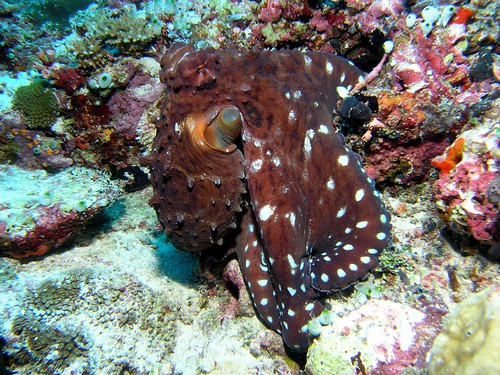
The Cyanea Octopus, otherwise known as the Day Octopus or Big Blue Octopus, is a fascinating little creature! here are some key facts about the Cyanea Octopus:

  • The Cyanea Octopus can be found in both the Pacific Ocean and Indian Ocean from Hawaii to the eastern coast of Africa.

  • This cephalopod growsto have a body approximately 16 cm and arms at least 80 cm.

  • When at rest, the Cyanea Octopus is brown in color, however they have the ability to rapidly change the color and texture of their skin to blend into their surroundings as a defense mechanism.

  • A characteristic feature of the Cyanea Octopus is their dark oval false-eye spots. These spots are present at the base of its arms and on the tips of its arms along with 2 rows of lighter spots. The dark eye-spots are only sometimes visible, as this octopus can change its appearance at will.

  • Cyanea Octopuses feed in daylight hours. Because of this, their camouflage skills are considered "exceptional" among the many species of octopuses.

  • The Cyanea octopus's complex brain sends nervous impulses to their muscles causing them to change appearances almost instantly as they move over sand, coral, rubble and other surfaces. One Day octopus was observed by octopus biologist Roger Hanlon changing patterns 1,000 times over a 7 hour period off the coast of Hawaii!

  • This octopus excavates lairs in coral reefs and associated rubble which can be located by identifying "middens" outside the lair entrance which are typically the empty shells of bivalves and crabs which it has preyed upon.